


Brainspotting
Book an appointment
Brainspotting (BSP) is a trauma-processing method developed by American psychotherapist David Grand that works directly on your brain through the direction of your gaze. It often makes accessible tensions and memories that are hard, or impossible, to put into words.
What is Brainspotting?
There’s an old saying that “the eyes are the window to the soul” – and modern brain research backs it up. There is a direct, anatomical link between how we move our eyes and what we feel.
Eye movement is largely governed by an area called the superior colliculus, which sits in the midbrain, at the top of the brainstem. Put simply, this area lies between two important systems:
- on one side, the limbic system – the emotional centre,
- on the other, the brainstem, which controls the body’s basic functions: breathing, heart rate, muscle tone.
Because of this, almost every strong emotion comes with some movement or fixing of the gaze. You’ve probably noticed your own eyes locking onto one spot when a bad memory hits. That isn’t random – it’s a sign of how closely the emotional and visual systems are wired together.
The diagram below shows this link: signals travelling from the eye reach both the emotional (limbic) system and the brainstem via the superior colliculus. That is why the eye can be used to “reach” the brain areas that hold unprocessed memories.
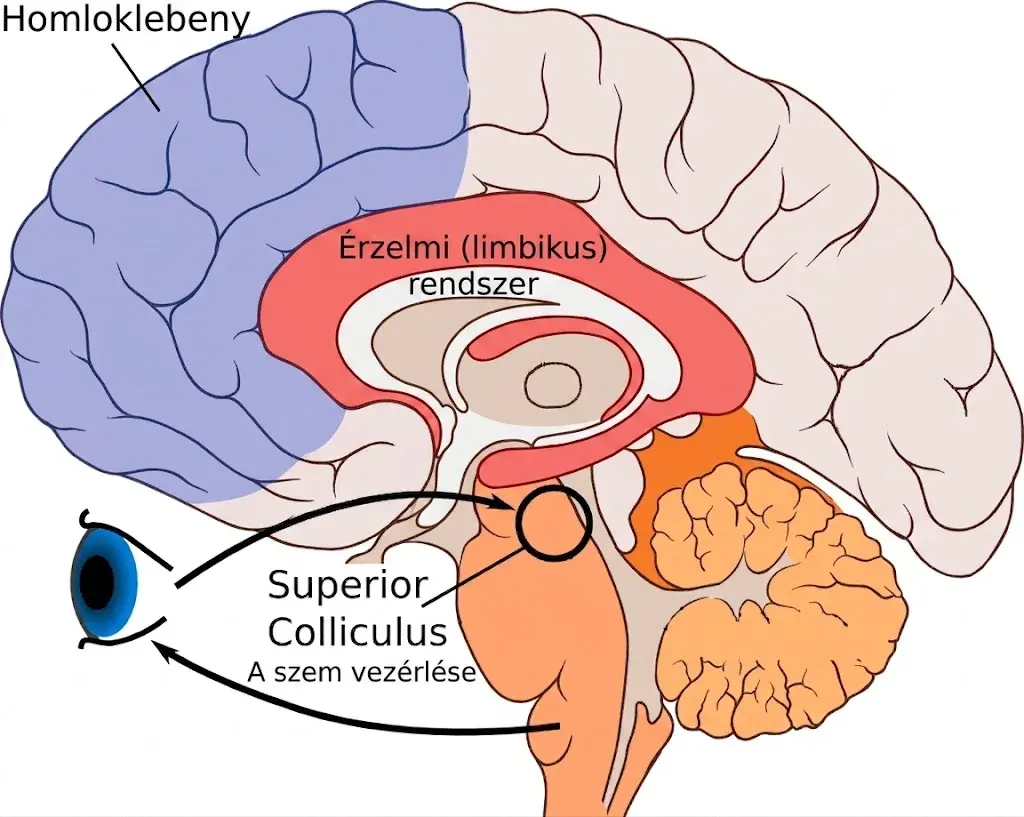
How the eye acts back on the brain
Brainspotting – like wingwave coaching – treats the eye not just as a mirror, but as a gate. If an emotion shows outward in the gaze, the reverse is also true: setting the eye in a specific direction acts back on the brain and reaches the area tied to a difficult memory.
According to the method’s model, the brain holds several such points (brainspots), each linked to an unresolved experience, and each with its own particular eye position. When you direct your gaze to that point and hold it there, your brain gets a quiet, safe frame in which to finish the processing that was left incomplete. The aim is for a trauma that keeps triggering flashbacks to gradually become a neutral memory: something you remember, but that no longer pulls you back.
How does a session work?
During the session, I’ll ask you to focus on a small pointer while I move it slowly in different directions. We watch how your emotions and body sensations change. When we find a spot where these intensify, we pause there, holding your gaze in place, giving your brain room to process the memory connected to that point.
We speak very little during this, sometimes not at all, while your brain does the work. I often use binaural music during sessions to help both hemispheres of the brain engage in the processing.
Who is it for?
I recommend Brainspotting especially if:
- you’ve already tried several therapies without a real breakthrough,
- you’re often overwhelmed by intense emotions or anxiety that are hard to ease,
- an emotional flashback keeps pulling you back into the same difficult experience,
- you’re in a situation that feels hopeless, and traditional talk-based methods haven’t moved the needle so far.
What to expect
Processing is intense inner work: feelings, body sensations, and memories are free to surface, held within a safe frame and my presence throughout. A session lasts until the emotional tension has noticeably eased. For many, the process brings not only relief from trauma but new self-insight and lasting inner calm.
Book a session
€90 per session (online or in person, 1.5 hours). Let’s talk about how Brainspotting can help in your situation. Get in touch, or if you’re ready, book directly in Győr or online.